Showing posts with label genetics. Show all posts

November 18, 2008

Yet More Grading

Have I mentioned lately how much I dislike grading?

Having just finished the term papers for the lab section I teach, I'm now grading exams. I drew what is apparently a more difficult couple of problems this time around. I don't personally think they're too tough; it's just a two-parter asking students to write out the genotypes of a couple of fruit flies and then use a Punnet square to predict the genotypes, phenotypes and genders of their offspring.

There are a lot of very strange fruitflies being born from this mating, though. Extra chromosomes keep cropping up in some, whereas others are males lacking a Y chromosome. Still others are lacking genes for one of the two traits involved.

I dislike grading because I don't like to be a bearer of bad news, and there are a lot of students who are going to be getting some bad news when these exams are handed back in a few days. Of course, I also dislike grading because it keeps me out of the lab. I've had to order some new primers and they won't come until tomorrow, so that's not as big a deal at the moment. My goal, though, is to get these exam responses done with today so that I can at least do a little bit of bench work tomorrow in between my other commitments for the day.

I plan on once more going after the cox1 gene from Neomida bicornis with the new primers. That, however, is a story for another day. For now... its back to grading.

Sphere: Related Content

November 11, 2008

Gel of the Day: A Horny Little Bug That's Pissing Me Off

Just for the record, I would like it known that the 3-4mm long diaperine beetles lumped together into the species Neomida bicornis are stinky stupid-heads and I don't want to play with them anymore.

What can I say after that deeply professional and scientific appraisal? Well, I can offer up this Gel of the Day as evidence of my contentions:

The first two lanes are 28S and 5.8S nuclear ribosomal subunits and the third is cox1 from Neomida bicornis. The last three are the same genes from a positive control, Bolitotherus cornutus. Everything else is, of course, the same. The same aliquots of primers, the same Taq polymerase, the same dNTPs, the same thermocycler protocol.

Now, if this were the first time I'd gotten a result like this, it would be no problem. And, in fact, it wasn't a problem four attempts ago. This gel is my fifth attempt at getting these sequences! I've tried tweaking everything I can think of with my existing protocol, but nothing changes the result. My next step will be to use a forensic DNA extraction and amplification kit, which I've been trying not to do because of the expense involved.

If not for the fact that I have some evidence that N. bicornis is more than one species, I would have given up on this by now. The thing is, it's worth it to me because part of my research has to do with the evolution of host specificity and I've collected this beetle from four different fungi now. Not only is the coloration different in these populations, but there are more subtle morphological differences as well (for example, the proportions of the tarsomeres of the metatarsi). I've also used the large subunit sequences from two populations — one from Ganoderma lucidum in Florida and one from Pycnoporus cinnibarinus in Massachusetts — in a molecular phylogenetic analysis and guess what... they turn out to fall into two separate clades with 99% bootstrap support in a neighbor-joining tree after 500 replications. In other words, they're taxonomically classified as a single species, but considering how slowly this sequence evolves it's highly unlikely that they really are. I need to get the more rapidly-evolving cox1 sequence to clinch this, along with analyzing a few more populations and I can't get the damned thing.

What a tease.

I mean, just look...

If I had hair, I'd be pulling it out right now. I can take or leave the small subunit, but I must have the cox1 sequence.

OK, that's it, "Neomida bicornis," if that is your real name. You've pushed me too far. Next time you see me on the street, you'd better run. I'm gonna be packing Raid.

Sphere: Related Content

August 26, 2008

Gel of the Day: What the Heck Happened Here?

Sometimes, a perfectly good gel gets funkified in the process of handling. I think that's what happened with this gel, which was otherwise indicative of a near-perfect PCR:
OuchyThe specimens in this case were three adult and one larval Bolitotherus cornutus which I collected at the MSA foray in Pennsylvania on August 10. The last eight lanes, 25-32, are from the larva. I haven't successfully sequenced a larva before; maybe my dissection technique is improving. The cox1 bands (31) look a bit weak, but the product should do for sequencing.

If you're familiar with electrophoresis gels or have at least been peeking at previous gels of the day, you're probably asking about now, "Mike, what the heck happened to lanes 21, 22 and 27?"

Well, I'll tell you. In order to take this photo using a UV light, I have to remove the gel from the casting tray, put it in a weigh boat and take it to a dark room upstairs from my lab. In the process of transferring the gel from tray to boat to camera, it gets a little scrape over an edge or two. This time, for whatever reason, that caused the bands in three lanes to get smeared. Nonetheless, there are bands there and since they are duplicates from two different dilutions (as far as specimen and gene go, 21=17, 22=18 and 27=31), it's not a problem.

Also, every fourth well is a control; there shouldn't be anything there. There seems to be a very faint band in lane 4, but it's nothing to worry about. I may just try and sequence it to see what the contamination is, since the position of that band is unlike that of any of the legitimate bands on this gel. I suspect that the culprit is a dirty microtube; if my primers, buffers, etc. had been contaminated, I would expect to see that phantom band in all of the control lanes.

The reason I'm running another batch of B. cornutus is that these are the first specimens I've collected from a site outside of Massachusetts. It's worth looking at them just to see if there are any polymorphisms present in introns in the sequences I'm analyzing.

I also read a very interesting paper today:

Leschen RAB and TR Buckley. 2007. Multistate characters and diet shifts: evolution of Erotylidae (Coleoptera). Systematic Biology 56(1):97-112. DOI: 10.1080/10635150701211844.
It's very much relevant to my own research. In this paper, Leschen and Buckley analyze the evolution of Erotylidae, a family of beetles only distantly related to the family I'm studying, and link their hyperdiversity to a shift to a diet of macrofungi. It sounds rather familiar, no? It's a very interesting read if you're into this sort of thing. It's based on morphology, not molecular biology, and finds a good link between diet and the external reproductive structure (gonocoxa and ovipositor) of Coleopteran females. Mycologists (at least those with an interest in basidiomycetes) and coleopterists alike will undoubtedly find something of interest in the paper. Enjoy.

Sphere: Related Content

August 22, 2008

Neomida bicornis: in ur pycnoporus tunnelin ur context

Photo (c)2005 by Jim McClarin, courtesy of BugGuide.netWhile dissecting some galleried Pycnoporus cinnibarinus this morning, I found another teneb that I hadn't encountered before. It's a horned member of the tribe Diaperini called Neomida bicornis (more info here). It looks exactly like the photo shown here except, of course, much much smaller. The male I found was 3.25mm long, 1.75mm wide and 1.15mm deep. It's the first beetle in Tenebrionidae I've collected from a Pycnoporus. Previously, I've collected a few Anthribinae from that fungus. The sporocarp from which I collected this beetle came from a spot in Wachusett that I've been checking since April.

While examining the insect, taking measurements and such, I dropped it on the black-speckled linoleum floor. I then spent about 20 minutes crawling around looking for the thing. You have no idea how quickly a tiny, dark-colored beetle can disappear, and it's the only one I've recovered so far. Since it's in Diaperinae, is apparently a context tunneler and doesn't damage the hymenium, it may prove to be an important data point for my overall work. Next week, I'll sequence it and see if it has a mutation in common with it's relative, Diaperis maculata.

Now that I know where to find them, I'll keep going back to that spot for more specimens. As small as they are, it will probably take a few tries to get clean DNA sequences and build solid consensus contigs. We shall see.

Sphere: Related Content

August 15, 2008

Bigfoot Press Conference: Early Report (yeah, it's a hoax)

Scientific American's Ivan Oransky has the first report coming out of the bigfoot press conference in Palo Alto. Not surprisingly, it's already looking very much like a hoax.

Tom Biscardi, Rick Dyer and Matthew Whitton didn't bring any physical evidence of the alleged sasquatch corpse to the press conference. What they did bring were the usual sort of blurry photographs that cryptozoologists/hucksters typically take. They also brought an email from a real scientist at the University of Minnesota, Curtis Nelson, that says nothing about any new species but does point up that if there are bigfoots (bigfeet?), they don't appear to be apes at all. Instead, it would seem that bigfot is what you get when you cross a native of North Georgia with a possum. Seriously.

Details at Ivan Oransky's 60 Second Science if you need more, and Oransky is promising further details as they develop. As for me, I've heard pretty much all I needed to. The bigfoot hunters don't have a leg to stand on.

Sphere: Related Content

August 05, 2008

Gel of the Day: Meat the Beetles!

Paul is a dead bug... miss him... miss him...
This Gel of the Day comes with a dedication to the unnamed UC Santa Cruz researcher whose car was blown up on Saturday by fruitcakes who want to liberate Drosophila.

The Fab Four in this case are four specimens of Diaperis maculata; John, Paul and George were collected together from a decomposing Piptoporus betulinus fruiting body. Ringo joined them later, having been recovered from a Ganoderma applanatum sporocarp. In each of the bosex, the first four lanes represent a 1:50 dilution and the second four a 1:100 dilution of the initial DNA solution. Lanes 1, 5, 9, 13, 17, 21, 25 and 29 are the nucLSU; 2, 6, 10, 14, 18, 22, 26 and 30 are nucSSU; 3, 7, 11, 15, 19, 23, 27 and 31 are cox1 amplified using the general Coleopteran PAT/JER primer set; 4, 8, 12, 16, 20, 24, 28 and 32 were an attempt to amplify cox1 using a custom-designed primer set that works on the other Tenebrionidae on which I've used it but apparently not on D. maculata. This is the same result I got last when I tried a competitive test of the cox1 primer sets on several species which also included another member of the same subfamily.

This might be a useful phylogenetic signal; it could very well indicate a mutation in the binding site for the new primer set which is conserved in all the other Tenebs for which I could find sequences (I could find none for D. maculata when I designed the primers). Moreover, an alignment from my previous attempt came up with an insertion and two transitions for D. maculata at a binding site that wasn't present in the other tenebs. I can't tell yet whether this is a species-specific situation or if the mutations are present in all members of the genus. I'm hoping to collect specimens of D. maculata' cousin, D. nigronotata, in Florida next month. If I can get sequences out of it, I will be able to say that much more about the evolution of genus Diaperis and perhaps about tribe Diaperini as well. That is, if Big Coleopterists don't Expel me over raising the slight possibility that the tribe might not be monophyletic and if no wackadoos with IEDs decide to set me on fire in my sleep.

Have I mentioned lately how cool it is to find something that nobody (as far as I can find in the literature) has seen before? This is the good stuff right here. This is why I get up in the morning and slave over a hot thermocycler.

Sphere: Related Content

August 01, 2008

Gel of the Day: Sarcodon what?

You might recall that I've twice now collected what I suspect to be a rarely-collected fungus, Sarcodon underwoodii, in the past few weeks. The first collection was made inside Worcester city limits on July 11 and the second time from the Wachusett State Reservation on July 17. I should mention that on my last trip to Wachusett all of the prospective S. underwoodii was gone and the more common S. imbricatum has replaced it entirely. The latter fungus has quite different coloration, the background being a red-brown instead of S. underwoodii's buff.

I've been trying to get enough DNA out of my collections to sequence and so make a positive identification so that I can let the people who manage the land on which I've made these collections know that they have an unusual species present. I tried earlier this week and got nothing. The context of the fungus is loaded with pigments that interfere with DNA amplification. I took a second pass at the problem, though, and let my samples digest in proteinase K for more than two hours during extraction. That seems to have done the trick. I've got PCR product galore and expect to sequence the nuclear ribosomal large subunit and ITS early next week. Here's the gel:

Sarcodon sp. gel
Lanes 3, 5 and 6 are from the fruiting body collected on July 11 and 7 through 12 are from the Wachusett specimen.

By middle of next week, I should know whether both of these really are S. underwoodii and increase what's known about the ecology of the two areas from which I collected them just a tiny bit.

Sphere: Related Content

July 20, 2008

The Very Long Sunday

It's 9:35 PM as I write this. It's been a long day. My sequences, however, are ready to go on the plate in the morning. I hope it's worth it. If I'm really lucky, I may find a mutation at the primer binding site of one or two species under tribe Diaperini when I get the reads back on Tuesday. If there is one there, it could turn out to be a very useful character in reconstructing Tenebrionidae phylogeny.

Or it could all be pure chance.

Like a slightly schizophrenic ex-girlfriend of mine once told me on an evening when her pupils were the size of basketballs, "You never know until you find out."

Me, I've got a scotch and soda in one hand and a remote control in the other. Time to turn the brain off for the night.

My day ended with an act of great generosity being made toward me. I ran out of cigarettes hours earlier but I was too busy with DNA-related stuff to leave and get some. On my way out the door, I bumped into CaKh, the Argentinian entomologist/biogeographer. He insisted on giving me 3/4 of a pack of Marlboros for the ride home. That might not be a big deal in some places, but in Massachusetts I believe that qualifies as a dowry.

Sphere: Related Content

July 14, 2008

Mystery Mushroom: Evolutionary Theory in Action

You might remember that a few days ago I collected some mystery mushrooms that I couldn’t identify based solely on macroscopic and microscopic characteristics. This morning, I got my rDNA sequences back and I’m happy to report that I have now been able to identify the fungus based on molecular characters. This is evolutionary theory put to practical application. Waddya know, this evolution stuff really works!

Here’s my final phylogenetic tree (although I could have collapsed the weakly-supported nodes if I'd wanted):


I produced this by matching my sequence against highly similar sequences in BLAST. I aligned these using MAFFT and then cleaned up the alignment in MacClade. The cladogram shown is a neighbor-joining tree created in MAFFT with branch lengths proportionate to phylogenetic distance. Bootstrap support is shown at all nodes and is the result of 500 replications. The taxon highlighted in red is my mystery mushroom and the clade containing its closest relatives is outlined in green.

As you can see, the unknown mushroom is clearly of the genus Gymnopus and is closest to, but not identical with, Gymnopus brunneigracilis. It may be that the mystery mushroom has not been sequenced before or I might need more characters to correctly identify it to species. Nonetheless, I do now know its genus and a photograph of one of its close relatives, G. luxurians, bears a striking resemblance. Moreover, the morphology and growth habits of G. luxurians are extremely similar to those of the mushroom I collected.

Imagine for a moment that this wasn’t a mushroom I found growing in wood chips. If this had been a mysterious fungus growing out of Aunt Tilly’s ear, I would have used the exact same techniques to diagnose our (thankfully) pretend parasite. None of this would have been possible without the principles of evolutionary theory, which informed every step of the process.

Of course, if you would like to try to identify the source of my sequence without resorting to evolutionary theory, by all means feel free. Here’s a link to the actual sequence from the fungus. I would be very interested in hearing all about how you made sense of it without involving mutations or knowing the genus and its relationship to other genera sharing a common ancestor.

Or, if you feel like trying your hand at this sort of thing, you can see pretty much the same things that I saw on the way to this result by using the links provided. If you don't feel like buying a copy of MacClade, you can substitute the freeware program BioEdit. It's all evolutionary theory in action embodied in software that makes life a lot easier than it used to be in the days of dot-plots and slide rules!

Sphere: Related Content

July 09, 2008

Gel of the Day: Mystery Mushroom


One of my lablings pointed out a cluster of mushrooms growing near the loading dock attached to our building the other day. Despite macroscopic and microscopic examination, we've been unable to identify it satisfactorily even to genus. The fact that it wasn't producing enough spores to obtain a print didn't help, and the few spores (fewer than two dozen) that I could find on the lamellae all had the same shape but their size and color varied. Some are colorless (hyaline), some are brown.

The gel above shows PCR products amplified from a small bit of the mushroom after drying. The first two bands are ITS and the second two are large subunit rDNA. Now that I have DNA, I can get the sequence and match it to known sequences. If anyone has sequenced this fungus before, we can identify it via molecular biology. If there's no exact match, the game still isn't over. Thanks to evolution, the sequences will still be closer to some fungi than others. If need be, I can do a quick alignment of similar sequences and then use phylogenetic software to determine to what the specimen is closest. With that much information, there's a very good chance it will be identified to species.

Next time someone tells you that they don't know anything practical that's based on evolutionary principles, ask them how they would have solved a problem like this if the fungus were eating the beams that support their house.

Sphere: Related Content

July 07, 2008

Reasons to Be Cheerful: DNA, Expeditions and Mycological Society Meeting

It's the little things in life sometimes that bring the greatest pleasures... at least when one revels in being a geek.

The first thing I need to do today is to clean up some DNA I have waiting in the freezer. Among them are the rDNA sequences from Diaperis maculata. Once I've cleaned the DNA I'll be able to load it onto a plate and will get the sequences back and be able to add them to my alignments. I'll know a tiny bit more about the evolution of fungus-associated Coleoptera. This is enough to make me look forward to a Monday. It's the little things... and D. maculata is only 5-6 mm long. That qualifies as "little."

I also have to start work on securing permits for the collecting expedition in September. Two months should be enough lead time, hypothetically, but one never knows with bureaucracies. We just need a couple of good sites to work at, though. I'll probably put feelers out on more than we'll actually use. That way if the process gets too long and we get turned down for a couple of sites at the last minute, we'll still have a couple of back-ups. Better to have it and not need it than to need it and not have it.

Speaking of science-related travel, it's only a month until I hit the road for Penn State and the annual Mycological Society of America meeting. It's the largest gathering of professional and amateur mycologists in the nation and promises to be a great time. I'm looking forward to the whole program, but I have to admit that I'm particularly tickled by the opportunity to collect in Pennsylvania, a state in which I've never forayed before. I'm even hauling my industrial-strength dehydrator on the trip so that folks can preserve specimens. The abstracts look like there will be some very interesting talks on fungal evolution and informatics tools. Folks from my lab are doing four of the presentations, I think. I'm not one of them yet (I've just started gathering data!) There are also a couple of talks by David Maddison that look like they'll be particularly interesting stuff. Days of full immersion... I can hardly wait.

Are any readers planning to attend MSA this year? If so, I'd love to meet up for a drink or two.

If you're new to this stuff and this is the first you're hearing about it and you'd like to attend, you can still register for the meeting. Even if you're a novice, you couldn't ask for a better opportunity to learn about fungi. Please consider joining us! If you're a newbie and can make it in time for the foray on August 10, I'd be more than happy to hang out with you in the field and help you get better acquainted with the various chitinous life-forms you'll encounter. I'd consider it a privilege to do so, in fact.

Today, and the next couple of months, are going to be great. Wonder-Geek Powers Activate!

Sphere: Related Content

July 03, 2008

Gel of the Day: Ambitious but Only Slightly Successful

I was feeling a bit ambitious today; my new COI primers arrived. They didn't work, but I did try them. Amplifying COI is turning out to be a bit tricky. I'm going to have to do some digging on this problem.

The mystery COIs from last time are still more or less a mystery... but they are at least Coleoptera and they are cytochrome oxidases. That much is good. There's nothing with better than 86% identity to them on GenBank, though, including what is supposed to be a Penthe species; I have my doubts as to whether that sequence is actually from that genus.

Anyhow, today's gel:


007 is my putative Pentaphyllus. I tried to amplify lsu and ssu from it. Didn't work. Neither did the same genes from Penthe pimelia (004). 009 and 010 are a pair of Bolitotherus cornutus; I got lsu and ssu from them but no COI. Why? I don't know. For some reason, I can't get any ribosomal sequences out of 007 and 004, only COI... and I can't get COI out of B. cornutus, even though they should all have the same conserved sequences. 015 is a new addition, Diaperis maculatus, a teneb from the subfamily Diaperinae. I only got the ribosomal sequences out of that one, too. Why? I don't know.

I'm neither entirely happy nor entirely unhappy with these products. I at least get to add some more data to my set, and that's something, anyhow. I'll clean and sequence these on Monday and chuck 'em into my alignment. I do wish I had gotten the Penthe and Pentaphyllus rDNA, though. It would have cleared up a couple of questions I still have about these two insects. I may be able to do another extraction from Penthe; it's a big bug and there's still enough left of my one specimen to try one more time. My Pentaphyllus stock is used up, though. They're tiny insects, 3-4 mm long, and I can only use heads and pronota for extraction to avoid contamination by gut symbionts. It's a bit like trying to suck the juice out of a pinhead.

Think I'll go have a nice Scotch now.

Sphere: Related Content

June 27, 2008

Gel of the Day: Epic Fail!

I hate it when I don't get PCR products on a Friday afternoon. I especially hate it when one of the attempts was extraction from a species of which I have but a single specimen. Blah.


#007 is Pentaphyllus sp. and #004 is Penthe pimelia. The latter was going to be an outgroup useful for rooting trees. What I've got is pretty useless, though, because it's nothing. As for Pentaphyllus, it looks like I got my small subunit product but nothing else. I'll take it and try the whole thing again over the weekend, I suppose. Or on Monday. I'm feeling a bit frustrated with the whole thing at the moment. I've got the COI and wingless dilutions down to 1:5, too.

Stupid bugs. How am I going to work out your phylogeny if you won't give me nice big globs of amplifiable DNA?

By the way, something about this blog and why I write about stuff like this. It occurred to me some time ago that there are a lot of people out there who have no idea what it's like doing research and who buy into the whole "big science" bullderdinky (like it? I just made it up.) There's a tendency to think that science is like what gets shown on TV and movies. Everything is gleaming and shiny and digital, hunches always pan out and the experiment always works. In real life that just ain't the way it is.

There are lots of blogs out there that review papers and deal with big issues in science. I like the idea of putting forth what life is like, how the successes and failures feel, and generally getting the point across that we science nerds are just like everybody else and that if there's anything like a "big science" conspiracy it has entirely passed by me and everyone I know.

Today? Epic fail. Tomorrow? Maybe not so epic fail. Maybe even success. In the meantime, I still need to go grocery shopping and, if I'm feeling up to it, do the dishes. See how that works?

Sphere: Related Content

June 20, 2008

Thoughts on Michael Dowd: Erroneous but Perhaps Positively So

Willington, CT is a bedroom community located about 5 miles from the University of Connecticut in Storrs. Michael Dowd spoke at its public library last night; the event was arranged by a local spiritual group whose leader, Bob DiQuattro, is an ordained minister and pastor of the United Church of Christ and grief counselor. It was clear from the outset that Dowd, dressed in a t-shirt, slacks and sandals, wasn’t going to be the fire and brimstone preacher type. Dowd demeanor conveys an identity more like that of a peace activist than a minister, more the self-help guru than the doctor of psychiatry. Two words that describe the instant impression of Dowd — and lingered for me through his talk — are, “nice guy.” I came away from his presentation without a doubt in my mind that Dowd isn’t up to anything that he isn’t perfectly willing to state in plain language. When Dowd says that he’s out to heal the rift between religion and science in America, that he thinks it crucial that religious people embrace evolutionary ideas as part of their theology, and that he wants to be a guest on “Oprah” in order to get his message out, he’s saying exactly what he mains. Whether his “evolution theology” can accomplish anything more than the third of these goals, however, I find highly questionable.

Dowd began his presentation with a pyramid that at its base had four principles of division between science and religion stated as “vs.” categories. For instance, the language of science was compared to that of religion as “day vs. night language,” with science speaking the former tongue and religion the latter. Day language is the language of facts and analysis, culturally non-specific and accessible to anyone regardless of religious context. Night language, the mother tongue of religions, is the semiological equivalent of dreams. It is bound to specific cultures so to time and geography. It isn’t literal; it has to be interpreted and this can only be done within its specific context. He illustrated the difference between these waking and dreaming lexicons by using the Genesis account of the temptation of Eve by the serpent in Eden. If one were to meet a talking snake on the way to one’s car, Dowd explained, we would wonder “who slipped us the LSD” because such an event would be far outside anything we could rationally expect to experience in waking consciousness. Yet people can still find truth in such a story by interpreting it in light of what we do know about the world. The serpent, Eve, Eden and the whole story are metaphorical but still convey information, in other words, about the human condition. Thus, he maintained, those who insist on a literal interpretation — he calls such people “flat-earth Christians” — are missing the whole point of the story and failing in both their role as spiritual and rational humans.

Another such distinction he examined was “public vs. private revelation.” Private revelation, like night language, is culturally and temporally specific. As he put it, “Moses went up on the mountain, something happened” and the result was a change that was relevant to a given culture. Private revelation is knew understanding of the working of the universe that comes through one person and is not universal. By “public revelation,” Dowd is referring to science, the “skeptical process” by which cultural specificity is stripped away in order to make understanding of reality universal. My understanding of this, then, boils down to the idea that Dowd’s “private revelation” is of limited scope and meaningful only to those who possess the right night language lexicon to decipher it, whereas “public revelation” is accessible to everyone. It’s an interesting idea, but this was the first area in which I find a basic flaw in Dowd’s ideas. The language of science is filled with jargon and concepts that are meaningful only to those who have put in the effort to become conversant with it. A lexicon is still required and there is no reason to expect that everyone will have the means to possess it, a situation which is illustrated in current science vs. religion debates. Every time a Creationist asserts that the Second Law of Thermodynamics makes evolutionary theory an impossibility, for example, they are demonstrating precisely that they don’t possess the right conceptual dictionary to comprehend the science implicit in their argument. In essence, this is really no different from a Christian mocking a Hindu for believing in many deities instead of one because the former doesn’t understand the “night language” of the other. In order for Dowd’s evolutionary theology to become adopted by anyone, then, it would be necessary for the potential adopter to either learn a number of other lexicons or else be willing to disregard the differences between them, whether we’re talking about religion or science. It’s a catch-22 situation as far as I can see, because inflexibly religious people aren’t going to do that and scientists have enough trouble keeping up with developments in their own field and unless their field has to do with religious experience they don’t have the time to learn the “night language” of other religions in order to foster dialogue between scientific skepticism and religious symbolism. Unfortunately for Dowd, who I think is absolutely sincere in his desire to see religion and science locked in a fond embrace, this is only the first of several such difficulties that ultimately leave us exactly where we started, even given his initial assumption that the reconciliation of reason and faith is necessary and productive.

The next tier on Dowd’s pyramid consisted of what he termed three fundamental scientific discoveries. The first of these, however, seems to me more of a personal interpretation of a basic property of self-organization. The label Dowd assigns to it is “nested creatheism,” and he stressed that the second word can be pronounced as either “cre-A-theism” or “cre-uh-theism.” He defines this as the spontaneous organization of simple components into more complex systems; subatomic particles assemble into atoms, atoms into molecules, molecules into organisms, organisms into societies, and creativity thus exists at every level in this analogy that he glyphs as a nested doll, with smaller dolls inside of larger ones. The largest doll, containing all the rest, is the universe, or God, or whatever other name one might attach to it. In set theory, this would be the infinite universal set. Dowd stressed that this isn’t a teleological principle; there’s no inherent purpose to it, it wasn’t designed and there isn’t a puppet-master pulling invisible strings to make it happen. This assertion brought to my mind something that John Allen Paulos wrote about in his recent book, Irreligion:

Some thinkers such as Albert Einstein, Stephen Hawking, and Baruch Spinoza seem to identify Him with the laws of physics or the structure of the universe…

— Irreligion, p 99

What Dowd appears to be talking about is, I think, better known as emergent properties. I don’t understand why there is a necessity to coin a new term to describe a fairly old concept, although this may be explained by the presence of emergence as another of the three scientific discoveries in this tier of Dowd’s pyramid. It may be that it’s just convenient to separate “spontaneous creativity” and emergent properties in order to make an esthetically-pleasing pyramid shape. In any case, this isn’t something new to scientists and I am not at all sure why those who oppose science in the name of religion would be inclined to accept a non-teleological basis for increased complexity. To the contrary, it seems that all Dowd has done here is recapitulate one of the issues that divides the religious fundamentalist from the naturalistic scientist.

The next level of Dowd’s pyramid consists of two approaches to understanding reality. On the one hand is the sectarian, religiously conservative approach by which religious texts are used as source material. On the other is the secular, religiously liberal approach, by which Dowd seemed to mean one that embraces empiricism rather than authority. I’m unclear on why this is important in Dowd’s “evolution theology”, aside perhaps from the notion that one has to use different language (again, night vs. day) in order for one side to make itself understandable to the other.

The capstone in Dowd’s pyramid is “a healthy future for the whole.” By reconciling all of these dichotomies and synthesizing science and religion, by the two sides understanding each other, we can bring about a transformation in the way that humans interact with the world that “aligns” us with the best interests of ecology and creates a better future. It’s a noble enough notion, certainly, but I’m not sure that Dowd’s belief that reconciliation of science and religion makes this possible or that incentivizing people to act in the best interests of the biosphere as a whole through their self-interest can ultimately pan out. Dowd expressed a few concepts in terms of gain theory (e.g., increasing strata of complexity resulting from emergent properties as “non-zero sum). There is another related concept: the red queen. That is to say that even when some biological or social system achieves an apparent equilibrium beneficial to all of its parts, sooner or later a cheater arises who exploits that very system for its own gains and by so doing can ultimately destroy it. Why this shouldn’t be expected to occur in the kind of system that Dowd envisions as a result of his evolution theology was never explained, nor was the red queen herself ever brought up. Dowd’s is a glittering Utopian vision and one that certainly feels good at an emotional level, but at the rational level based on empirical understanding of how evolution really works it is an exceptionally unlikely scenario for anything more than a brief historical period.

I’ve already critiqued Dowd a good deal and yet have barely gotten into his presentation, so I want to make clear that I can see a lot of potential good in Dowd’s message, flawed though it is. While few people are going to devote themselves to a full understanding of evolutionary theory or scientific knowledge because of what Dowd has to say, I do think that he can provide a ground upon which the religious can get over the assumption that science is out to obscure what they feel are religious truths. They may not actually learn much about science, but I think that merely having this feel-good view of it is a useful thing. While I find it hard to believe that Dowd is going to sway religious fundamentalists of any stripe, and as a scientist I don’t find myself transformed in any way by the presentation, his message is a good one for middle America to hear. It may allay some fears when it comes to talking about the content of science education, for example, and that in itself is an important point to keep in mind. I don’t, and never have expected, that everyone in America would ever become a scientist and so it isn’t necessary for the bulk of the population to have a detailed understanding of biology. What is important is that half or more of our population isn’t frightened by those of us who do and that they get over the notion that their children are going to be indoctrinated into some sort of science-based cult by receiving a sound education themselves. Dowd provides a warm-and-fuzzy way for this to happen, and that’s far more critical at this juncture in history than that every American citizen understand what fitness means in terms of natural selection and the fine points of how self-splicing genetic sequences can alter the course of evolutionary history. Fundamentalism flourishes in an environment of fear; Dowd may be a good agent for countering that situation. He might make for a poor scientist, but he’d be an excellent guest on the talk show circuit. By all means, put the man on “Oprah.”

A theme that ran throughout Dowd’s presentation, and which also formed one of the basal blocks of his pyramid is the difference between faith and belief. Faith, in Dowd’s interpretation, is simply an open and trusting stance in regard to the universe and the result of interpretation of religious stories. Belief is particular; it relies on the acceptance of religious imagery as literal truth. In other words, a Christian might read a story from the New Testament and interpret it in light of worldly knowledge and so come to an understanding that no matter what happens, everything will be alright in the end. Alternatively, he might read the same story and thereafter insist that Jesus literally walked on water and that an actual multicephalic dragon was going to emerge from the center of the earth at the end of time. The former is faith, the latter is belief. Belief is counterproductive, faith is not. This works fine on the religious side of the spectrum, bt what about when it comes to science? Dowd asserted that he finds faith arising from an understanding of cataclysms throughout evolutionary history because each mass extinction was followed by adaptive radiation and speciation. In other words, life will always find a way. He finds faith in DNA, too. During the brief question and answer period, I was one of three people who got to ask a question. My question was that, being that I look at genetic sequences nearly every day and don’t find a reason to trust the universe anymore than I already do because of it, where in DNA can one find reason for increasing faith? Dowd’s response to my question was to refer back to periods of rapid evolution following cataclysmic extinction events. Frankly, I don’t feel that he really addressed my question on this point. I still don’t see any reason to be more open and trusting based on the alignment of genetic sequences that are already so much a part of my existence based on the continuation of biology through periods of destruction. Dowd seems to be saying that these impersonal bits of life’s history can serve as a model for getting through times of crisis in one’s own life. Our personal disasters are tiny as compared to those that have befallen the earth in the past and everything worked out for the better for life, so that should be a sign to us that we’ll emerge better for our individual tribulations, too. This presupposes that it’s true that life on earth is better for having been nearly wiped out in the past, but we have no way of knowing whether the world would be better off if the evolutionary trajectory of dinosaurs had continued to the exclusion of the eventual rise of primates. We can only take the personal view in the first place that things as they are constitute the best of all possible worlds because we’re here to say so. Moreover, observation tells us that many people in the world are not better off because they trust in an essential goodness of the universe or God or even other people. There are any number of disasters that occur in people’s lives that are never resolved for the better; someone who dies of cancer or who loses everything they ever had and winds up homeless and starving can take little solace in the fact that the asteroid that killed off the sauropods likely made it possible for we humans to eventually come into existence and there’s no good reason that they should. This part of Dowd’s evolution theology reminded me far more of self-help ideology than it did of anything that we can logically infer from science. Indeed, it would only make sense in a system that incorporated a teleological, “everything happens for a reason” element, which science manifestly does not. It’s a bit of warm-and-fuzzy, certainly, but in and of itself doesn’t appear to me as anything that couldn’t result from a literal interpretation of scripture.

In a general sense, what Dowd is bringing to the discussion isn’t anything new. Most of what he talked about were things I’ve seen in various mystical ideas; Dowd has a lot in common with Ramakrishna, for example. What’s new here is that Dowd is trying to incorporate intrinsically scientific principles into a mysticism that turns them into universal exposition of what were previously culturally-specific ideas expressed by religions that were based in part on dreamlike symbolism and in part on imperfect and limited understanding of all of the mechanisms by which the world works (as I’ve said in the past, religions are attempts to explain the world that were formulated with the best tools available at the time but which aren’t as good as those we have now, and so those who cling to literalism do a disservice both to religion and progress). There’s a hidden danger in doing this, because his efforts could certainly serve as an alarm to those who’ve been insisting all along that science is a religion. They could well point to Dowd as an example of someone who is trying to replace religion with science and who disregards, for example, the notion of non-overlapping magisteria. I haven’t looked for examples of this to date, but I’m sure I could find at least a few if I tried.

To the extent that Dowd is a novelty in the context of the ongoing “culture wars” in America and elsewhere, I do think we’ll be hearing more about him, and all-in-all I see no problem with that. He could make the situation a little better and I don’t think he could make it much worse. On the other hand, I don’t see a basis for thinking that his ideas are going to change things overall. Considering that he closed his presentation with the hope that lessons from biology could serve as the basis for a new system of government, I’m inclined to hope that he doesn’t garner too much influence. I don’t think that would be a good idea; biology is explanatory and it can and should inform relevant decisions made by governments, but I would certainly vote against any candidate for office who thought that our system of government should look like a biological system. Evolutionary biology shows us that the history of life is rather harsh overall, that it’s driven by competition and destruction. I wouldn’t want to live in a society that used natural selection as a basis for inclusion. One of the great things about humanity is that we can do much more than mere biology would allow because our capacities to imagine and envision are emergent properties that have been produced from evolutionary processes. We’re the first species that we know of that can step outside the confines of pure biology, so we needn’t — and shouldn’t — be limited by biology itself.

In summation, then, Dowd is interesting, but I think he’s still falling into many of the traps that mystics throughout history have encountered. His desire to see the reconciliation of science and religion is noble in and of itself but his ideas don’t really constitute a means by which this can happen unless he’s talking to an audience that has already decided that such a reconciliation is possible in the first place, which essentially means that both religious fundamentalists and so-called “new atheists” — the very people he most needs to reach — are very unlikely to accept his message. While he acknowledged repeatedly that evolution isn’t soft and cuddly, he largely misses out or passes over the points from evolutionary biology that run counter to a Utopian vision for the future at either the personal or societal level. Dowd certainly isn’t an evangelical Christian in the sense that we normally see that term used, nor is he a scientist or science teacher. He shares a good deal of methodology with self-help mavens, though, and audiences open to the spiritualistic sources like The Secret are the ones most likely to be receptive to his ideas. While I think he’s in error about what evolutionary biology tells us about ourselves and abut the world, his errors are at least positive ones. Considering what we have before us in American society today, I find myself in favor of his continuing to get his message out, if only because it stands to replace erroneous thinking that is inimical to science with erroneous thinking that at least leaves the door open for the continuation of scientific progress.

Sphere: Related Content

June 19, 2008

I Can Haz PCR Product? Only Can Haz Saitokrowm.

Ah well.


Lane 18 is COI from a female B. cornutus. I got nothing from the male and no wingless from either one. Not sure why, but I'll tweak some more later.

Sphere: Related Content

June 18, 2008

I Can Haz PCR Produkt

In rather happier and more personal news, I finally got PCR product out of Bolitotherus cornutus, my first successful attempt at doing so.

The gel shown here demonstrates that I successfully amplified DNA from my samples. This was extracted from the pronota of two B. cornutus, one male and one female. Not all the amplifications worked, though. The lanes labeled 1, 5, 9 and 13 are a segment of the large ribosomal subunit rDNA and those labeles 2, 6, 10 and 14 are the small subunit sequences. Lanes labeled 8 or below are using a 1:100 dilution and those labeled 9 or higher a 1:500 DNA dilution. The lower dilution clearly works better; I get at least two of my four products.

Two other sequences, the wingless gene and cytochrome oxidase 1 (COI) didn't amplify at all. That's probably because there are only a small number of copies of these present in the total genome, unlike the much-duplicated ribosomal sequences. I'll try a lower dilution, maybe just 1:20, and have another go at those later.

Mind you, I haven't actually sequenced these yet. This only shows that I amplified ribosomal DNA from something. While the primers I used are supposed to be beetle-specific, there's still a possibility that I'm looking at DNA that came from something that lives inside the beetle. I won't know that until I get back sequences and try aligning them with known ones.

That's the less likely scenario, though. This is just a small step forward for me, but I'm feeling pretty good about it at the moment. As for today, I expect to be spending more time in the field than in the lab. I'll get to cleaning and readying my products either late today or on tomorrow.

Sphere: Related Content

June 16, 2008

Tricky Insect Will Tell Me Its Secrets

I had been planning on going into the field with two of my lablings today but the weatherman convinced me otherwise with dire warnings of hail and damaging winds — neither of which has materialized. We'll go out on Wednesday instead. Sigh.

On my previous trip to Wachusett on June 11, I found a beetle in a decaying cluster of Pholiota squarrosoides that I thought at the time was an Eleodes. I was wrong.

Penthe pimelia courtesy of BugGuide.netOne of the things I'm trying to learn is to be able to look at a beetle in the field and at least identify it to family. Being able to say whether or not something was in Tenebrionidae would save me a lot of useless collecting. The beetle family that contains the one I found, though, doesn't make that any easier (and Tenebrionidae are already so variable that it's not an easy task to pick one out without recourse to counting tarsal and antenna segments). It's a mock teneb, so close morphologically to true Tenebrionidae that its family is referred to colloquially as the "false darkling beetles." The family it belongs to is Tetratomidae and the species is Penthe pimelia, sometimes called the velvety bark beetle. It's not really a bark beetle; it's another fungus-eater and sometime dweller that usually specializes on polypores. In this case, though, it happened to be working on an agaricoid when it was captured and dropped into 1.5 ml of 200-proof ethanol.

This beetle looks so much like a teneb that I wonder why it isn't classed with them. It has the same number of joints in its foot, the same number of antenomeres. As variable as tenebs are it's surprising that taxonomists relying exclusively on morphological characters put it in a different family.

Only a few nucleotide sequences have been obtained from this beetle to date, if indeed they are from the same species as the specimen I have. I'm going to start work on getting more sequences out of my voucher specimen tomorrow and see if I can't add to the 16S mtRNA, 18S nucRNA and COI partials. I'm going to go after another chunk of the LSU, the SSU and the wingless gene, too. After that I'll see for myself whether or not it might be a teneb (eventually, anyhow). Even if t isn't, it should make a perfect outgroup for the rest of Tenebrionidae I use in this study.

Right now, I'm just killing time waiting to see if I got a product out of Bolitotherus cornutus. The gel is running. If I can sequence it, it will be the first time (at least as far as GenBank is concerned) that anyone has done so. Fingers (tarsi?) crossed.

EDIT (4:09 PM) - No PCR products from B. cornutus. Crap. I'll have to start over again tomorrow.

Sphere: Related Content

June 10, 2008

Maine Creationists Continue Gibbering

Even though it has been nearly a month since School Administrative District 59 in Maine rejected the nonsense put forth by Young Earth Creationist Matthew Linkletter, his gibbering co-Creationists continue their, well, gibbering. A letter from one of them appears in todays Morning Sentinel and even in terms of the usual blithering ignorance of science that we're all used to hearing from these people it's still pretty awful.

When law meets theory, theory must give way

I've met Matthew Linkletter a couple of times and I believe he has a keen intellect.

I think you people at the Sentinel editorial board know perfectly well that Linkletter's comments about evolution are factually correct. All you've ever advanced as evidence for evolution is the say-so of scientists who cannot stomach the idea of being held accountable for their actions by God.

Not too long ago, the same crowd was insisting that the world was flat.

No one on either side of the debate denies that natural selection is taking place. Natural selection is simply the interaction of all life and the environment on one another, causing a certain amount of adaptation by life forms to better survive. Natural selection does not explain where life, or the environment, came from, nor does evolution.

Mathematics does not support evolution. The odds of lighting striking a mud puddle and creating life have been calculated and found to be a mathematical impossibility.

Genetics does not support evolution. The human gene code is increasingly in decay. This decay is called genetic load. It's like sticks on a camel's back. When the genetic load reaches a certain point, mankind will become extinct.

The diligent can easily search out the truth. To Norman Dean, I would simply say Law of Entropy. When a law meets a mere theory, the theory must give way. Entropy is why people die, and it does the same to the theory of evolution.

Bruce Clavette
Athens
It's entirely possible that Matthew Linkletter has a keen intellect — when compared to Bruce Clavette. It's hard to imagine that he could be much duller at the very least.

The say-so of scientists is called — wait for it now — science. That's what gets taught in science classes. That "say-so" is backed up by facts, by research, by mathematical modeling. We're not just making this stuff up, but Clavette is right insofar as all he knows about it is the "say-so of scientists." If he did research himself, then he could be part of that "say-so" because he, too, would be a scientist. History, to that extent, is the "say-so" of historians. Mathematics is the "say-so" of mathematicians. See how this works? If the "say-so" of lumberjacks was taught in science class, that wouldn't qualify as teaching science. Ditto for the "say-so" of Creationists. Clavette, by the way, runs a municipal waste dump for a living. Garbage in, garbage out.

Natural selection doesn't cause adaptation, it selects upon adaptations that already exist and so increases or decreases the frequency of certain traits in particular populations. In order to generate new adaptations, mutation is necessary. Evolutionary biology includes both of these, and together (along with a number of other mechanisms of which I doubt Clavette is aware) they do an excellent job of explaining where life as we see it today came from and so the origin of the biotic part of modern environments.

Evolution isn't predicated on lightning striking mud puddles, and where Clavette comes up with this stuff is unknown to me. Mathematics supports evolution very well; evolutionary biologists use it all the time. One thing is for certain — there is nothing in any math of which I'm aware that prevents lightning striking puddles. The probability of lightning striking a particular puddle is vanishingly small, but the nature of statistics is such that if you have enough time, puddles and enough thunder storms the odds that one of those puddles will be hit by lightning eventually approaches certainty. Clavette apparently doesn't understand statistics any better than he understands biology.

Genetics supports evolutionary theory in every single case it's been looked at. Clavette, however, chooses to serve up what is perhaps the most muddle-headed point in his whole obtuse letter here. The concept of genetic load was first put forth by biologist JBS Haldane, the same man who, when asked about what biology has to say about God wryly and famously replied that it demonstrates that "He has an inordinate fondness for beetles." The concept of genetic load — itself a facet of evolutionary theory — doesn't tell us that mankind is going to become extinct due to the decay of our genome. It merely states that the loss of alleles in a population comes with some cost. It cannot be looked at in isolation, because new alleles are also generated sometimes and some alleles are never lost but go to fixation, meaning that all members of a population can carry the same allele and so the allele will continue to exist for so long as some other factor doesn't wipe out the population. Deleterious alleles are usually lost with greater frequency than beneficial ones due to natural selection. The potential does exist for a population to accumulate one or more alleles so deleterious that it will become extinct, but this is unusual. Clavette is acting a lot more like a prophet than a scientist when he asserts that mankind's genome is falling apart and that we'll eventually become extinct due to this "decay." I'm not aware of any scientific evidence for it, so unless Clavette has been doing some research into the history of the human genome on his own — in which case he ought to publish his findings — he's just making up stories here. This is why the "say-so" of scientists is taught in science classrooms, by the way. Students would be poorly served, indeed, if schools were to instead teach the "say-so" of people like Clavette.

Finally, Clavette brings up the hoary Creationist canard of the law of entropy, that bastardized version of the second law of thermodynamics. Need it be pointed out yet again that entropy increases irreversibly only in systems that are isolated from the input of energy from their environment — and biological systems don't qualify as isolated systems as evidence by the fact that Bruce Clavette, like every other living thing on the planet, regularly takes in energy in the form of nutrition? In other words, if it has a metabolism, it isn't an isolated system and isn't subject solely to the second law of thermodynamics. As long as energy is input into a system, entropy is overcome by that energy. It isn't just entropy that causes death; what causes death is the accumulation of small defects that aren't repaired because of the inherent imperfection of biological systems in the utilization of energy for creating chemical bonds, for example. Ultimately, we wear down like any machine. If it were simply unbridled entropy, as Clavette seems to think, we'd never live in the first place.

Clavette has a problem with scientists whose "say-so" doesn't include supernatural intervention. Instead, he wants to substitute the "say-so" of people who don't have the first inkling about scientific knowledge, a condition that Clavette demonstrates exists in himself in this letter. He then wants to call that "science" and teach it to students in his home state. If this were to be done, there would be no point to education. Why bother teaching students to be ignorant when ignorance is precisely the absence of education? Why not just have them memorize scriptural passages while squatting in a field somewhere and leave it at that?

I suspect that this would be just fine with Clavette. In fact if his letter is any indication of his educational history, there's a good chance that this sums up his early years quite well.

Sphere: Related Content

June 06, 2008

Southern Lawyers and Anti-Evolutionism, or What the Heck Are They Teaching at Samford University?

I wrote a couple of days ago about a lawyer from Baton Rouge, Louisiana who made some wildly illogical incorrect claims about evolutionary theory. This morning there's another example. This time, the person in question isn't quite a lawyer yet. He's a third year law student at the University of Alabama. Previously, he received a degree in biology from Samford University in Birmingham, AL. The motto of this school, according to its website, is "For God, for learning, forever." The student and letter-writer in question is named Christopher Brinson and his letter to the editor appears in the Montgomery Advertiser. Having read the epistle, I'm left with two questions.

First, what is it about Southern lawyers and misunderstandings/mischaracterization of evolutionary theory and knowledge of evolutionary biology in general? They seem to be a particularly vocal group in their opposition to it, yet they don't appear very knowledgeable about these things.

Second, what the heck is being taught as biology at Samford University? The claims that Brinson makes, particularly that "As one progresses in college-level and postgraduate-level study of such evolution, talk of the macroevolution advocated in today's junior high and high school classrooms is rarely mentioned," lead me to believe that he managed to get a degree in biology from this university without learning about evolutionary theory at all. The courses I took relevant to evolutionary biology as an undergraduate certainly contained a good deal of information about speciation, and as a graduate student I'm completely immersed in what Creationist-types routinely refer to as "macroevolution." Speciation of both fungi and insects, in fact, forms the basis for my dissertation work. I literally couldn't research what I'm working on if there weren't both discussion of and evidence for new species — in fact, new genera, subfamilies and families — arising from old ones. Brinson's claims simply don't make sense in the light of current knowledge. How can he be making them at all if a biology degree from Samford University is worth the paper upon which their diplomas are printed?

ALABAMA VOICES: Teach relevant science

By Christopher Brinson


The recent release of the Ben Stein-narrated movie "Expelled" returns many of us to a long-running debate over the place of the theory of Darwinian evolution in our classrooms. Despite what many of the media's "talking heads" say, this is a debate well worth our time to have.
I'm not one of the media's talking heads; I'm a graduate student doing research in evolutionary biology. Nonetheless, I maintain that this isn't a debate worth having because I work with principles of evolutionary theory every day. The debate is a cultural one, a political one, and certainly not a scientific one. It is not a fitting debate in science classrooms, and Expelled is a propaganda piece that never advances any alternative theories; it only raises socio-political objections. That Brinson and other non-biologists (someone seeking a law degree is not a biologist, after all) who already hold positions that Brinson expresses in his letter get riled up by a mockumentary that preaches to the faithful has no bearing whatsoever on the scientific validity of evolutionary theory.
...each species will evolve -- albeit on a microevolutionary scale -- through a "survival of the fittest" type process, which Darwin noticed in his study of the numerous species found on the Galapagos Islands.

Understanding of this concept is valuable to students of genetics in particular, because it can help us understand how to prevent genetic diseases, including various birth defects and cancer.
Already we see the product of inadequate education in biology at work here. Brinson is taking a solely ecological view of evolution and thus relying on an argument not about evolutionary theory as a whole but solely upon natural selection. In truth, all natural selection tells us about genetic diseases is that organisms that have them are less likely to pass on their genetic material to a new generation. It doesn't really tell us anything at all about how these defects arise in the first place. Brinson has it backwards; knowing about natural selection doesn't teach us about genetics; it is genetics that provides an understanding of how natural selection works. One could know nothing at all about the mechanisms of genetics and still have a theory of natural selection, which in fact was the case with Darwin himself and with husbandrymen for thousands of years before him. Genetics clarifies the molecular basis upon which natural selection works. Natural selection itself doesn't tell us a thing about how to prevent cancer and it certainly can't tell us anything about how to prevent genetic disorders aside from telling us that organisms that have them aren't as likely to reproduce as those that don't under most circumstances, so it's better not to try mating them and thereby producing weakened offspring under artificial conditions.
As one progresses in college-level and postgraduate-level study of such evolution, talk of the macroevolution advocated in today's junior high and high school classrooms is rarely mentioned. Why? Because it is honestly not particularly useful for meaningful solutions to our current biological problems that we are researching...
This is simply untrue. It may be true at Samford University, of course, and I feel safe in saying that "macroevolution" isn't taught in the law classes that Brinson is taking, but in the world of valid biology education, Brinson's statement here is simply wrong, as I've noted above.

As far as the "biological problems we're researching," who is "we," exactly? Brinson certainly isn't researching any biological problems at all. Not all researchers are involved in solving problems about human genetic conditions, either. As I've mentioned, the problems I'm working on are specifically about how two groups of organisms affect each other's evolutionary histories and so have shaped the forms in which we find them today. Is Brinson suggesting that understanding such things shouldn't be researched? If he's saying that there's no "macroevolution" (e.g., evolutionary change above the level of population genetic structure), I can easily enough demonstrate that he's wrong with a tiny glimpse from my own work.
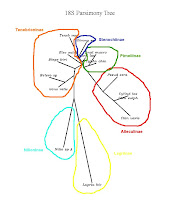
Beetle evolutionThe rather cartoonish and crude diagram to the right is a simple, unrooted, parsimony-based tree I've constructed based upon the 18S rDNA of beetles in the Tenebrionidae that I collected from GenBank using BLAST. I then aligned them using ClustalW and MacClade and reconstructed the tree using PHYLIP. There's an error in attribution of one of the sequences that has a small impact on the structure of the tree — this is just a quick-and-dirty reconstruction that I used to look at the monophyly of subfamilies — but it demonstrates the evolutionary history and relatedness of not only different species of Tenebrionidae, but of genera, tribes and subfamilies thereof. Many of the insects in this tree are very different from one another, both in terms of morphology and behavior, but one can see in a broad sense how these clades of organisms arose. Brinson is saying that "macroevolution" isn't discussed at the postgraduate level and isn't a useful concept for research. I'm a bit unclear on the term, so I'll leave it as a question; is what I'm showing here an example of "macroevolution" based on evidence other than fossils? Is it not useful in understanding how diversity arose in a specific instance and so applicable to a further understanding of how the evolution of two entirely different groups of organisms might have affected one another?

I can only conclude that Brinson doesn't know what he's talking about. His argument seems to be based on his personal experience at Samford University, not on any knowledge of universities in general nor upon any first-hand knowledge of research.
However, in the classrooms of our seventh and 10th grades, the theory of evolution is not taught in the form in which it is indisputably occurs. Instead, it is taught as some sort of mechanism for explaining how all life forms on this great Earth were created and how we as human beings came into existence.

This itself is not useful and not sound science. One of the most basic laws of biology is that life cannot arise from non-life. Further, there is very little hard evidence that large-scale evolution of species ever occurred.

All we have is the fossil record, which does indeed offer evidence that many of our species are closely related. But this does not prove that each evolved into the other...
The first sentence of that first paragraph doesn't parse very well, but Brinson seems to be saying that evolution is a mechanism. In fact, evolution is a number of different mechanisms that all work differently but have cumulative effects, one such effect being the diversification of organisms. It is taught as the means by which life forms, including humans, that we see today came into existence, and that's because every shred of evidence ever found supports it. As I've already shown, Brinson is rather ignorant if he thinks that "all we have is the fossil record." To date, I haven't touched a fossil and don't expect that they will be a major part of the data that I gather for my own work. That's not a problem at all, because we have plenty of other evidence and I'm in the process right now of looking at that evidence and testing it empirically. Believe me, if I find anything that appears to negate some part of evolutionary theory, you'll be hearing about it. So far, no such thing has occurred. It's possible that it will, but it's not at all likely. Far more likely, I'll be applying evolutionary principles and not contradicting them. I'm certainly open to the possibility of discovering something entirely new, though, and thereby revolutionizing biology. Wish me luck, eh?

Point being, Brinson, like the lawyer I wrote about yesterday, seems to be pulling his arguments out of his nethermost orifice. I see no evidence at all that he understands the subjects he's arguing against. Again, I must ask how someone could earn a degree from Samford University without ever learning anything about molecular biology or even speciation.
I could delve further into the weaknesses of macroevolution, but it would require much more space than this article allows. The point is that macroevolution is useful for little more than speculation...
If by "speculation" Brinson means the ability to reconstruct the history of life on earth and gain a better understanding of how organisms might influence one another's history, thereby generating a new and finer comprehension of everything from natural resource management to parasitology, then he has a point. Somehow I don't think that's what he means. Brinson, I fear, doesn't have any grasp of how basic research can be translated into application and probably isn't even aware of the tremendous spectrum of research in the biological sciences.
It will not help the cancer researcher find a cure. It will not help us eliminate some of our worst human defects. It only causes controversy between those who hold certain strong religious beliefs and believe in moral absolutes and those who believe in moral relevancy.
Strange, but Brinson seems to me to be advocating precisely for that controversy. As far as not helping cancer researchers find a cure, it actually can... by helping target for investigation organisms that are likely to produce useful compounds, for example. While my own research has nothing whatsoever to do with finding a cure for cancer, it could ultimately be applied to preserving endangered species that might yield useful therapeutics (I don't know that, of course, but it's possible). There is more to science, of course, than curing diseases. The pursuit of knowledge for its own sake, I would assert, is a valuable undertaking. Anything that yields a better understanding of the world in which we live can ultimately benefit we humans — and perhaps other organisms with which we share the planet. Their lives, too, are worthwhile, if in different ways from how we think about the value of human life. I don't know about Brinson, but I enjoy cohabiting this globe with other living things and would be quite unhappy if the surface of the earth were covered end-to-end with nothing but people.
If America is to regain its footing as a nation leading the world in science education, our educational system should focus on the most pertinent and cutting-edge science, as well as proven and well-tested laws and theories of biology, chemistry and physics...
News flash for Christopher Brinson; many of them already do. Samford, apparently, didn't.
This starts with making science relevant. Second, debate over controversial scientific theories should be embraced, not thwarted. And finally, our education should ensure that students are able to use and understand the foundations of science, not side-circus issues that only arouse deep passions. Currently that is not the case...
So anything that doesn't cure a disease is a "side-circus?" That's what all of science should be? Most scientists don't research cures for disease, you know. We'll almost certainly never cure AIDS with an efficient semiconductor and high-energy physics is unlikely to yield new treatments for pancreatic cancer. And yes, our educational system should work to insure that students understand the basics of science; Brinson himself provides a good example of the failings in that undertaking, I'm sorry to say. He seems entirely unaware of just how hypotheses are tested, and even how the various principles that are comprised by a theory are tested — something that real scientists must do every day.
I am not saying that evolution should not be taught in public schools. I am saying that the focus should be on microevolution, which allows us to understand much of modern medicine. And on the issue of macroevolution, debate should be encouraged, and it should be robust.
What is this obsession with medicine? Didn't he learn about any other fields of research at Samford, or is the biology program there geared entirely to churning out doctors — and discouraging scientists? I'd love it if someone in an official capacity at that university could explain why one of their graduates seems to have such a narrow view of the full scope of life sciences research. Moreover, how did this person graduate without understanding that "macroevolution" (e.g., speciation) is nothing more than the accumulation of smaller changes at the population level ("microevolution")? How could a biology department so thoroughly fail one of their students that someone who has this in their biographical line at the end of their letter to the editor:
Christopher Brinson... graduated cum laude from Samford University with a degree in biology.
isn't aware of such a basic part of evolutionary theory — one that I heard over and over again while a biology undergraduate at Florida State which, let's face it, isn't exactly an Ivy League school itself?

Brinson's arguments, his whole letter, seems like it must be the product of a profound ignorance of both the research community and of evolutionary biology. Yet on Samford's biology department website, there appears a statement on evolution (strange that they would need such a formal statement to begin with, but there it is) which states in part:
...Evolution, a foundational concept in biology, has been established through empirical evidence, and the consensus of the scientific community is that evolution is the best explanation for the origins of biological diversity. Because an understanding of evolution is critical to the advancement of human health, the preservation of our environment, and an understanding of biological processes, our department strongly supports the teaching of evolution as an essential component of a quality education in the sciences...
If this is the case, how do you wind up with a Christopher Brinson holding a degree in biology, and graduating cum laude, no less?

The motto of Samford makes me a little suspicious, but their department website makes it seem like their biology department is reputable enough. What went wrong here?

EDIT: It seems that Brinson is, indeed, highly motivated by politics, perhaps with a touch of Dominionism thrown in for good measure. A bit of research turns up that he is a former director of collegiate outreach for an organization called Redeem the Vote. A look at their website today reveals headlines such as "Sex and the Sissy" and a diatribe against same-sex marriage, too. The group partners with the Trinity Broadcasting Network, Christian Broadcasting Network and the American Tract Society. Brinson appears to have numerous credentials with the fundamentalist movement. His rather ridiculous letter to the editor is no doubt an "on-target message," given the latest "strengths and weaknesses" strategy being employed by Fundamentalist foot soldiers. His background isn't made clear on the Montgomery Alabama letter, and I suspect he may have gotten a biology degree mainly as a way to make himself seem somewhat credible in making this kind of argument.

Sphere: Related Content

June 05, 2008

Deep-Down Crazies and the Demon-Haunted World

I stumbled across something today that just blew me away with its craziness. Granted, I've never been able to feel any sympathy for the Millennialist mindset, the strongly-held belief that the world is about to be purged of most of humanity at any moment for the benefit of true-believers. I don't live in a world haunted by giants from alternate realities and demons and angels. I'm firmly of the opinion that man's achievements and man's problems are man's, not supernatural entities hovering invisibly over our shoulders and waiting for some final confrontation.

Still, there are people who seem to spend a lot of their time hoping for massive destruction and pain and death. How does one live with such a morose view of the world?

The End is In Sight
By Ron Graham


In Matthew 24 Jesus gives a quick sketch of what the end times would look like, but He doesn't go into intricate detail. Everyone knows what wars are and rumors of wars. This isn't really a sign since earth has had wars and rumors of wars since time began. Later in this chapter He refers to the days of Noe (Noah). Again He just gives a sketch because everyone knew what He meant when referring to the days of Noe (Noah).Just before the Flood there was the almost complete corruption of the human genome by the fallen angels...
Mmmmm, I love the smell of blood libel of the whole human race in the morning. Smells like... ewwww. It's a silly thing when fanatics get hold of scientific terminology.
n Genesis chapter 6 we're given a very scary scenario. Somehow fallen angels (sons of God) co-habited with human women to create a complete hybrid race of super beings. They were known as the Nephilim and only Noah and his family were spared from this corruption from the seed of Satan...
A complete hybrid race of super beings; all of humanity, in this mythology, were super beings. Clark Kent is the anti-Christ, people!
Jesus being fully God is telling us that the end of the world will be in sight when these things (Matthew 24) begin to come to pass. So just what are we expected to see come to pass in these last days? We see man inventing new ways to create new life such as cloning. We see genetics being manipulated by scientists who have their own agendas. It was Satan that introduced his seed into the human genome in the days of Noah and it is Satan that is manipulating men's minds and actions in hopes of corrupting this current civilization. Just like in the times of Noah, just before the flood waters came...
Ah, the evil scientist hypothesis; we're out there "manipulating genetics" willy-nilly to suit "our own agenda" because Satan is manipulating our minds. But wait... if Satan is manipulating our minds, how can we have "our own agenda?" And if doing so will result in the purging of the world, then why would Satan be doing it, anyhow? You'd think the Prince of Darkness would be able to read Ron Graham's ravings and even the Book of Matthew and all of that. I know, I know, it doesn't have to make sense. Mythology has the luxury of being incoherent. Religious fantasy doesn't have to be rational; reason is the enemy of faith.
Civilization has now advanced to a place in time that just a few years ago would have been considered science fiction. Yet here we are living out our greatest fears. The demonic activity in this world is pervasive and easily noticeable by those with a discerning eye. Advancing civilization through gene manipulation to obtain a completely new species of human is quite frankly an abomination to God, and just as He did before the flood, God will put a stop to Satan's plans.


The reasoning behind these incredible feats of genetic manipulation is to provide us with ways to increase our life span (which it hasn't), to eliminate disease (which it hasn't), to give the humans on this planet a complete makeover so to speak (have you seen the human ear growing out of the mouse's back?)

Don't be fooled into believing Satan's demonic emissaries. Satan is here to supplant God's authority on earth and ring in his own creation, a creation of Nephilim...
Apparently, manipulating the genomes of crops in order to prevent diseases that wipe them out is "demonic." Investigating ways to eliminate heritable diseases is demonic, and it's just a ruse to cover the real agenda of creating super beings called Nephilim which, as we'll learn later, are 13 feet tall. Yeah, that's what we need; 13 foot tall super beings.

How exactly does growing an ear on the back of a mouse qualify as an effort to "make over" humanity, anyhow? The point of that experiment, as I recall, was to investigate techniques for growing tissue replacements for the maimed and diseased. Is Graham trying to say that part of science's nefarious plan is to breed a race of 13 foot tall superhumans with mice growing out of their ears? I don't think the NSF has a grant for that.
As we watch the world changing before our very eyes, Jesus' words come shinning through time and time again. The end of this secular world is quickly approaching...
Repent! The end is nigh! The internet has given a safe, dry home to those who would formerly have been forced to don sandwich boards in the streets in order to frighten the children. News flash for this particular crazy (although I know he won't read it and wouldn't accept it if he did): the world has been changing since the dawn of time, and human society has been changing since such a thing first came into the world. Change of any sprt scares the hell into these people, though, and it always will. The answer is always in the dim Bronze Age past; anything new is the work of Satan. What must that be like?
Believers should be watching with anticipation for the next sign. The Nephilim re-immerging could easily be that sign. It should be impossible to miss them. These evil hybrids were huge, standing over thirteen feet tall with immense strength. Those who believe the Bible's explanation of the Nephilim have no problem understanding the building of those great monumental structures we see around the globe that have scientists baffled as to their origin. Were extraterrestrials responsible for the pyramids at Giza, or Stonehenge, or any of the other unexplainable phenomenons all over this planet? Not extraterrestrials but intre-dimensional...
You heard it here, folks. Stonehenge was built by 13 foot tall superhuman hybrids from another dimension. Humans couldn't possibly have built the pyramids because... well... for some reason. It's much more believable that giant monsters from an alternate reality did it — if you're out of your mind. Mind you, even while waiting for the end of the world, people who believe in this nonsense are the same ones who want to set educational curricula. I bet Don McElroy agrees with a lot of this stuff.

Jesus, save me from the "intre-dimensional" 13 foot tall supermen!
People, the end is in sight. What that means is all the signs Jesus said were going to happen at the end just before His return have become quite evident right now.

Nothing more needs to happen before the Rapture of His Church. There's a number that needs to be reached, a final number to complete the Church. So the next person you witness to who turns their life over to Jesus may be that final number. Get busy!
This nutcase is not only gleefully anticipating the deaths of most of the human race, he's urging fellow believers to work hard to make it happen. According to this homicidal fantasy, all that needs to happen is for a certain number of people to convert to this particularly malevolent religion and then fire will rain from the skies and billions will be wiped out... but they're not really human, anyhow. Most of humanity, according to this author, are the result of "ungodly unions" and not people at all but superhuman 13-foot tall hybrids from another dimension who want to grow mice on their ears and build pyramids. It all makes sense now.

Honestly, I can't fathom what it must be like to live with a mentality that dehumanizes humanity to the point that one hopes it will be essentially wiped out. Not just to hope for it, but to work for it. Fundamentalists like to say that religion is necessary for morality, but to me it looks from articles like Graham's that it's role in this murderous psychology is to create a proxy that will do the dirty work of killing for the sake of the faithful. Instead of picking up an automatic weapon and firing on the "Nephilim" from some campus clock tower or flooding a subway with nerve gas, the Millennialist true-believer works to insure the creation of the conditions for the coming of a cosmic hitman.

People believe this stuff. This is what reality looks like to them. Can anyone explain how this doesn't qualify as a pathological condition?

Sphere: Related Content